
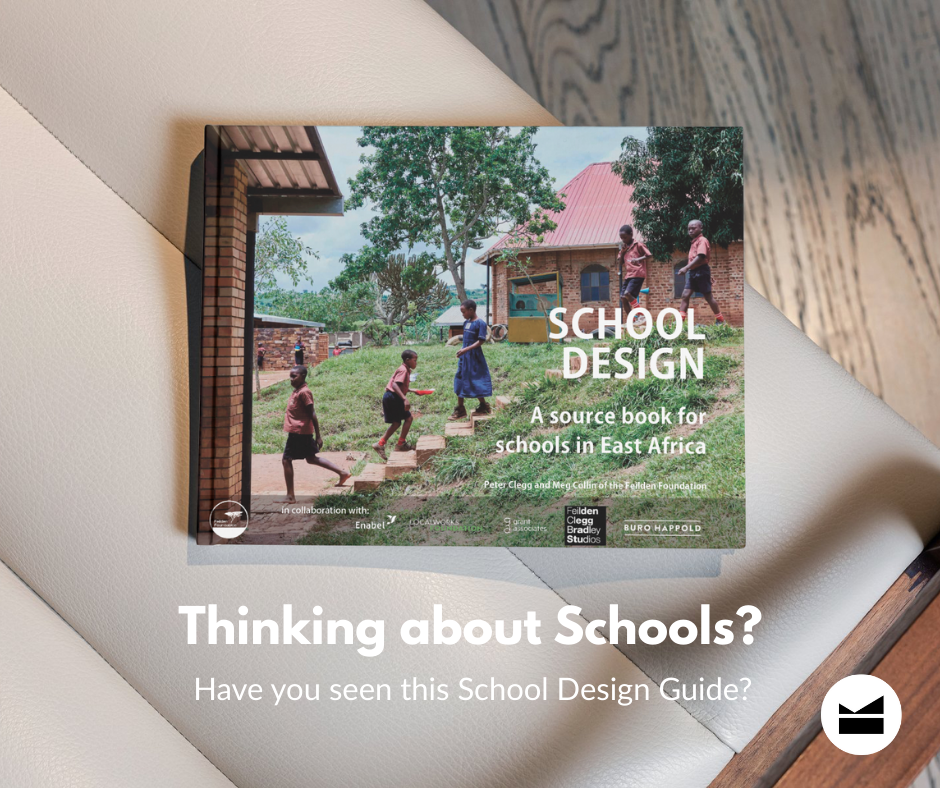
This school design guide, made by Enabel, the Belgian development agency, in partnership with the Feilden Foundation and a network of local and international stakeholders offers a comprehensive framework for creating sustainable and inclusive educational facilities in East Africa.
It prioritises a participatory design process that integrates local community needs, cultural values, and environmental data into the early planning stages. The guide outlines critical technical considerations, including budget management, structural efficiency, and the use of low-carbon materials to ensure long-term durability. Special emphasis is placed on passive ventilation, natural lighting, and reliable water harvesting systems to support hygiene and comfort.
Furthermore, the guide highlights the importance of accessibility for all learners and provides modular strategies for incremental growth and replicability. Ultimately, the document serves as a manual for building schools that empower local populations while addressing maintenance and environmental stewardship.

Learnings
Understanding climatic and environmental design is critical for organisations and charities because it determines the long-term sustainability, health outcomes, and financial viability of educational facilities. This understanding shifts school building from a mere construction project to a tool for healthy social and economic development.
Influence on Social Impact
Climate-responsive design directly affects the well-being and attainment of students.
• Concentration and Attainment: Poorly designed, overheating classrooms significantly reduce a child’s ability to focus; however, using bioclimatic strategies like natural ventilation and solar-protected daylighting provides a comfortable environment conducive to learning at low operational costs.
• Health and Hygiene (WASH): Integrating Water, Sanitation, and Hygiene (WASH) from the outset ensures a healthy environment. For example, providing private, maintainable facilities for girls is a social priority that reduces barriers to attendance, particularly concerning menstrual hygiene.
• Inclusivity and Safety: Design decisions must account for physical and emotional challenges. Environmental features like ramped pathways and covered walkways ensure that children with disabilities have equal access and dignity.
• Community Connection: Schools often serve as the “heart of the community,” acting as meeting places or refuges during extreme weather.
Influence on Economic Decisions
Organisations must balance initial capital investment against lifetime operational costs.
• Robustness vs Maintenance: Most schools cannot afford regular upkeep; therefore, using robust materials and good craftsmanship can “design out” the need for maintenance, saving money in the long run even if initial costs are higher.
• Local Material Selection: Choosing locally sourced, low-carbon materials like compressed earth blocks or local stone reduces transportation costs and minimises the project’s carbon footprint.
• Productive Landscapes: Utilising school grounds for small-scale agriculture or kitchen gardens improves student nutrition and can generate income or reduce food expenses, which are often a school’s largest cost.
• Phasing and Flexibility: Financial constraints often require phased construction. Planning a site for future vertical extensions or multi-purpose spaces (like halls that can be rented for weddings) ensures the facility is future-proofed and economically adaptable.
How the Guide Supports Organisations
The guide serves as a source book of practical knowledge and best practices based on research from over 40 schools. It supports charities and organisations through:
• Methodological Frameworks: It provides a participatory design methodology, helping organisations engage local communities to build trust and ensure project longevity through local ownership.
• Planning Tools: Organisations can use the schedules of accommodation requirements to accurately estimate building areas and spatial needs for different pupil numbers and age groups.
• Technical Guidance: It offers specific advice on ground engineering, seismic conditions, and sustainable drainage, which mitigates the risk of structural failure or flood damage.
• Case Studies: By presenting exemplar schemes from the region, the guide demonstrates how pioneering, low-carbon designs have been successfully implemented in various East African contexts.
In essence, a well-designed school follows the principle of having a
“good set of boots and a good hat”
the “boots” are strong, waterproof foundations that resist ground-level hazards, while the “hat” is a broad roof that protects inhabitants from the harsh sun and heavy rain.
To see the full guide and learn more, find the full guide here: Download Here